Caring for a Wedding Dress or a Vintage Piece After the Event
The day is over and the dress is in a bag. What happens in the next few weeks decides what it looks like when you open the box again.
October 27, 2026 · 4 min read
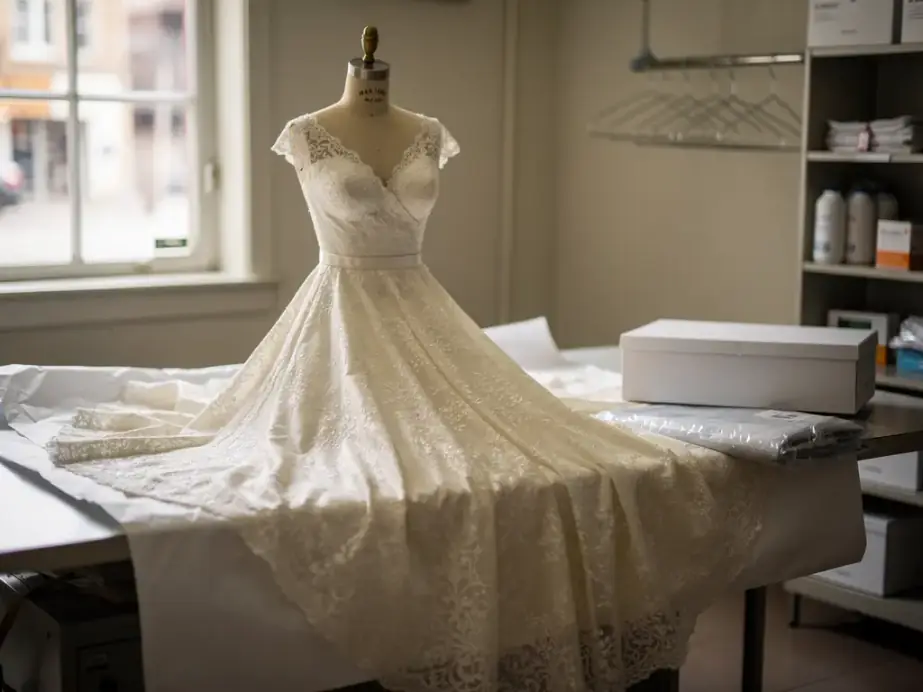
The morning after a wedding, a dress can look perfectly clean. Then it goes into a closet, and over the following months it changes. Champagne, white wine, cake frosting and perspiration all dry clear, and that's exactly the problem. Sugar stains oxidize and slowly turn yellow or brown, quietly, usually long after anyone is looking. A hem that dragged across a dance floor or a lawn is carrying dirt that sits in the fabric the whole time.
Cleaning soon gives a cleaner much more to work with than cleaning in five years, when you open the box to find a map of tan spots. The same goes for a gown worn to a gala, a christening gown, a tuxedo, a prom dress you mean to keep. Anything formal that you plan to hold onto deserves a cleaning before it's put away, not after.
Tell the counter what happened
Walk through the day. Where did it get wet, who hugged you with a drink in hand, did the hem touch the grass. Point out anything you know about, and mention the invisible things too, since a clear spill is the one nobody can see. Say if the dress has beading, lace, sequins, a train, a bustle or a lining.
Royal Cleaners says it cleans formalwear, including wedding dresses, and takes extra precautions so delicate fabrics and embellishments are preserved. Those precautions work best when the person doing them knows what they're protecting.
Vintage is a different conversation
A dress from your grandmother's closet, a 1950s cocktail suit from a flea market, a silk scarf that's been in the family for decades: these pieces don't behave like new clothes. Older silk can be fragile enough to split along a fold. Seams that were sound in 1962 may have weakened. Dyes can be less stable. Metal fasteners may have rusted and left marks. A home wash that would be fine on a modern cotton dress can end a vintage piece.
Royal Cleaners lists restoration and preservation of vintage clothing and wedding wear among its services, and says it has significant experience with vintage and delicate fabrics, including heirloom dresses and antique garments. Before anything is done, the useful step is a look at what you've actually got and an honest answer about what's realistic.
Be ready for that honesty. Sometimes the right call is a gentle cleaning. Sometimes it's a repair first. And sometimes the best thing for a fragile piece is to leave it mostly as it is and store it properly.
Cleaning and preservation are two jobs
Cleaning removes what's on the garment. Preservation is about what happens afterward, during the years the piece sits in storage. Whoever does the cleaning, the habits below are what keep the result from undoing itself.
- Store it clean. Anything left on the fabric keeps working on it while the dress sits.
- Keep it cool, dry and dark, in a closet inside the living space of the house. Attics and basements swing too hot, too cold and too damp.
- Avoid sealed plastic for the long term, since plastic traps moisture. A breathable cotton bag, or a storage box with acid-free tissue, is the usual advice.
- Support the weight. A heavy beaded gown on a hanger can stretch its own bodice. Laid flat in a box with tissue in the folds, the weight is spread out.
- Pad every fold with tissue, and if you open the box every year or two, refold along slightly different lines so no crease wears through.
- Keep it away from direct light, which fades dyes and yellows white fabric.
How a particular gown should be stored depends on its fabric and its decoration. A lace gown and a beaded satin one don't ask for the same thing. Ask at the counter what preservation options are available for your piece and what they'd advise for it.
Wearing it again, or passing it on
Plenty of people take a mother's or grandmother's dress and wear it again, or cut a long gown down for a shorter occasion. That's a job for a seamstress, and Royal Cleaners has one on site. Their alterations cover resizing dresses, taking in seams, shortening hems and replacing zippers.
With an older piece, the question is how much spare fabric is tucked inside the seams, and whether the fabric itself is strong enough to be restitched. Ask early, ideally before you fall in love with a plan. A tailor looking at the actual garment can tell you in a minute what a description over the phone can't.
A small timeline
- The week after the event: bring the dress in, with your notes on what happened and where.
- At drop-off: ask for an estimated pickup date, since delicate work can take longer than a standard order.
- At pickup: look it over under good light, with the person at the counter, before you take it home.
- At home: store it the way you were advised, and put a reminder in your calendar to look at it again in a year.
Dry cleaning at Royal Cleaners is typically ready in two to three business days, but gowns and heirloom pieces are the kind of job where the pickup date is worth asking about instead of assuming.
Before you come in
The shop is at 814 San Pablo Avenue in Albany, open Monday to Friday from 7 to 2 and Saturday from 8:30 to 2:30. There is no pick-up and delivery, so you'll be carrying the piece in yourself. Lay a gown flat in the back of the car instead of folding it over a seat. Call (510) 323-4167 if you'd like to talk it through before you bring it by.
Royal Cleaners, (510) 323-4167
Call (510) 323-4167More articles
What to Do in the First Hour After a Red Wine, Coffee or Ink Spill
The first sixty minutes decide more than any product in your cabinet, and most of the damage comes from what people do next.
Getting a Hem or a Taken-In Dress Right: What to Bring to the Fitting
Most bad hems come from a fitting where the wrong shoes, the wrong layers or the wrong expectations walked in the door.